
Switch to Induction Cooking

Category

Food

Impact

Cost

$
There are Multiple Ways to “Clean up and Green up” Your Cooking Appliances

Electric stoves, especially induction stoves, can make a difference for health, safety, the environment, and the climate. If you currently use gas in the kitchen, you can electrify your cooking with new induction cooktops, ranges, and other electric appliances — and then you can zero out emissions and air pollution by opting up to Acton Power Choice Green for a 100% green electricity supply. Switching from gas or propane stoves to an electric stove is great because you will be reducing greenhouse gas emissions and improving indoor air quality, but going to an electric induction stove is even better!

Induction cooktops and stoves can cook faster, more safely, and more responsively. Most importantly, induction cooking is healthier for children. (See Stanford Report, May 2024.) As an added bonus, induction makes for easier cleanup than either gas or traditional electric stoves. Induction stoves make the cooking vessel itself the heat source and so induction cooktops use roughly 10% less energy than electric burners and up to half the energy of gas.


Induction Cooking
  • How fast is it?

You know the phrase a watched pot never boils – if you have about 4 minutes – induction stoves can prove that saying wrong. How fast it heats up and cools down is one of the things that people really like most about cooking with induction.

  • Why is induction safer?
      • Fewer chances of getting burned or hurt.  They do not involve an open flame nor is the “burner” surface hot (unless a heated pan is on it) which is unlike electric resistance and gas burners that are very hot and stay very hot long after they have been turned off.
      • No more leaving burners on accidentally  Virtually all induction stoves now turn off automatically if it no longer senses a vessel on it or if it senses the burner is excessively hot.
      • Better for indoor air quality. It does not produce hazardous or greenhouse gas combustion products [e.g., nitrogen dioxide (NO2), carbon monoxide (CO), and carbon dioxide CO2] that occur when burning natural gas or propane. Also because the cooktop does not get hot or have an open flame, things that fall or boil over onto it are unlikely to burn and create combustion related fumes or smoke.
      • No possibility for gas leaks – because it doesn’t use natural gas.
  • How does it work?
    • An induction stove creates a localized electromagnetic field and the field generates a fast-moving current (called an eddy current) inside the metals in your cookware (e.g., a pot, skillet, frying pan, or cast iron pan. This fast-moving current runs into resistance in your pan and generates the heat that cooks your food or boils your water.
    • You need induction ready/compatible cookware. If a magnet sticks to the bottom of your pot/pan it will work (like cast iron and most types of stainless steel), but cookware made of aluminum and copper will not. There is a lot of great induction cookware out there.
  • A $500 Rebate
  • A potential problem with pacemakers?
    • If you get within 2 to 3 feet of an induction stove when it is on, the electromagnetic field may interfere with the operation of certain medical devices. Check with your physician to see if your pacemaker or device would be affected.
Want to Test Drive Induction?

If you are curious to experience induction cooking at home and want to see how amazing induction cooking can be, you can


Other Ways to Expand Electric Appliance Usage to Reduce/Eliminate Reliance on Gas for Cooking.
  • buy an inexpensive portable induction cooktop to augment your existing system
  • replace your gas stove with an induction, electric coil, or glass top stove/oven
  • use small electric cooking appliances, when suitable, such as a pressure cooker, crock pot, rice cooker, electric kettle, and toaster oven (instead of using a gas appliance)

These options are described further under the Deep Dive section.
 

Steps to Take

  1. Assess your current gas stove. Is it time to make a change? Amazing induction cooktops are becoming the preferred cooking method of chefs around the world.  They are a great choice to reduce indoor air pollution and your kitchen’s contribution to the greenhouse gas emissions caused by natural gas.
  2. Test drive an induction cooktop. Discover how amazing induction cooking is! Borrow a portable induction cooktop at Acton Memorial Library or local shop, Kitchen Outfitters. Or visit an appliance store with a demonstration model.
  3. Research pros and cons to see if it is right for you. In addition to the information above, have a look at the testimonials below from local cooks to see what they think about induction technology, and also check the links in the Deep Dive section below for more information. Websites like Consumer Reports can help you evaluate some options, brands, models, and price. Also, sources like The Spruce have periodic reviews.
  4. Check to see if your cooking pots and pans are induction ready. If a magnet sticks to the bottom of your pot/pan, that item of cookware is induction ready. (Flat-bottomed pots/pans yield the best results.)
  5. Check out local appliance stores to see available options for induction cooking and counter top kettles, cookers, and other electric appliances. Local kitchen stores carry portable induction cooktops and appliance stores carry full induction stoves.
  6. Share your experience. After you’ve bought an induction cooktop or stove, please tell us what you think and provide your testimonial below.


Deep Dive

Reasons To Choose Electric Cooking

There are many important reasons for choosing electric cooking over cooking with gas including: combating climate change as well as environmental, and health benefits which can be further amplified when the electricity you use is renewably sourced. See Acton Power Choice GREEN for 100% renewable electricity.

1.  What Are The Concerns With Using Fossil (“Natural”) Gas? 

Fossil gas does burn relatively cleanly. However, despite best intentions and technologies, fossil gas leaks are rampant, from the origin at fracking well sites, throughout pipelines and compressor stations, and from the infrastructure under our streets (see the Heet annual gas leaks map for Massachusetts) and in our homes. These leaks release methane, unburned, into the atmosphere where it has a disproportionately large impact as a greenhouse gas and negatively impacts our climate. Fossil gas is largely methane (95%) and methane is a super potent greenhouse gas — with 86 times the warming impact of carbon dioxide (over the first 20 years, which is the period that matters for mitigating short term climate impacts). Leaking fossil gas is neither clean, nor safe, nor efficient.  As of the end of 2024, utilities reported 122 open leaks and 106 repaired leaks in Acton. These leaks were responsible for 80 metric tons of methane emissions, equivalent to 6,844 metric tons of carbon dioxide, or $110,615 of leaked gas (at residential rate).

To complicate the dangers of fossil gas even more, the gas we use in our homes today is not our “grandparents’ gas” and may contain many other hazardous compounds. All the fossil gas now being supplied to our region has been fracked, or mixed with fracked gas, and contains chemicals that linger from the fracking process. Many of the chemicals used in fracking fluid, including methanol, ethylene glycol, and propargyl alcohol, are considered hazardous to human health. However, the potential human health impacts of a majority of chemicals used in fracking formulas are also unknown. Although there are rules requiring disclosure of chemicals used in fracking, those rules often contain exclusions for “confidential business information (CBI). USEPA (the U.S. Environmental Protection Agency) reviewed more than 39,000 chemical disclosure forms submitted to FracFocus from January 1, 2011, to February 28, 2013; it found that more than 70% of the forms listed at least one chemical as CBI and that 11% of all chemicals were claimed as such.

2.  What are the Health Effects of Cooking with Gas?

In May of 2020, a report titled Health Effects from Gas Stove Pollution, by Brady Anne Seals and Andee Krasner, was released by the Rocky Mountain Institute, Physicians for Social Responsibility, Mothers Out Front, and Sierra Club. Mothers Out Front summarized the report as follows:

“Over 40 years of evidence indicates that gas stoves, common in kitchens across the United States, can lead to unhealthy levels of indoor air pollution.” This report synthesizes expert findings into eight key points:

    1. Indoor air is largely unregulated and is often more polluted than outdoor air.
    2. Gas stoves can be a large source of toxic pollutants indoors.
    3. Indoor pollution from gas stoves can reach levels that would be illegal outdoors. 
    4. There are well-documented risks to respiratory health from gas stove pollution.
    5. Children are particularly at risk of respiratory illnesses associated with gas stove pollution.* 
    6. Lower-income households may be at higher risk of gas stove pollution exposure.
    7. Ventilation is critical but is not the sole strategy to prevent exposure.

Electric cooking is a cleaner household cooking option.

“The study concluded that replacing gas stoves with electric stoves produces the greatest decrease in indoor nitrogen dioxide (NO2) concentrations. The results show that the simple intervention of replacing a stove may not only dramatically reduce indoor NO2 levels in the kitchen but also throughout the home. Unlike relying on exhaust hoods or other pollution control options that depend on people using them, replacing a gas stove with an electric (including induction) stove can decrease pollutants at the source.”

* Children exposed to gas cooking have increased odds of current asthma … and lifetime asthma, according to numerous recent studies in Europe (2023) and the United States (2024).  Here is a summary article from U Health at the University of Utah.

If you use a gas stove, it is important to provide and use adequate ventilation. See the research on Health Effects from Gas Stove Pollution.

3.  What Is Induction Stovetop Cooking And Why Do I Need To Know About It?

Induction stovetops can cook faster, more safely, and with more-accurate control and easier cleanup — all while reducing greenhouse gas emissions and improving indoor air quality. Let’s focus on how amazing induction is:

  • Induction is powered by electricity and electricity can be renewably sourced (See Acton Power Choice Green).
  • Induction cooktops are extremely energy efficient, fast, and precise because induction technology transfers energy directly into magnetic cookware.
  • Induction has become the preferred choice of many chefs and restaurants, as shown in the post “Professional Chefs Love Induction Cooking and You Should Too!
  • Less chances of getting burned or hurt. Unlike gas, electric coil, or glass top radiant electric cooktops, induction cooktops heat the pot through the energy between the metal pot and magnets beneath the smooth glass top — yet the smooth cooktop surface itself remains relatively cool. And unlike other cooking methods, it does not use flames or red-hot elements to cook. There is no loss of energy through radiating heat from the surface. Kitchens are cooler. Induction is safe for use around children, elders, and those who may forget to turn the stove off. Virtually all induction stoves now turn off automatically if it no longer senses a vessel on it or if it senses the burner is excessively hot.
  • Induction is finally becoming popular. Although induction technology has been around for 70 years or so, and has long been popular in Europe and Asia, it’s been slow to catch on with U.S. consumers — until recently. First introduced at the World’s Fair in Chicago in 1933, induction cooking now comprises 8% of the market share for cooktops and ranges, and that proportion is growing.
4.  What Other Options Are Available To Electrify The Kitchen?

Electric appliances can be used for many cooking processes; examples of such appliances include pressure cookers, crock pots, rice cookers, electric kettles, air fryers, and counter-top oven appliances. Of course, these are available on the web or from big-box stores, but consider going local and thrifty. Some of these items are commonly found at consignment stores, Goodwill, Savers, or the Habitat for Humanity ReStore. You can post your search (as an ISO/in search of) on local Facebook freebie pages, Freecycle networks, or Craigslist! For new items, consider shopping with local, independent retailers.

5. Websites For Additional Information

For more information you may want to look at the following web pages.

How induction stoves work (Rewiring America)

Induction Cooking (Massachusetts Clean Energy Center)

Electric Cooktops  (MassSave)

3 Best Induction Ranges of 2026, Lab-Tested and Reviewed (Consumer Reports)

Testimonials

We changed from an electric coil stove to an induction.  In addition to its helping to save the planet, it's not only easy to use…
Hurray for induction stove tops!!
Submitted by: Carolyn Platt
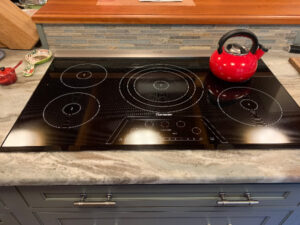
I switched from a gas cooktop to an induction cooktop when we renovated our kitchen. The Thermodor induction cooktop we installed looks sleak and modern…
I love My Induction Cooktop
Submitted by: jodi macdonald
I purchased a portable induction cooktop and now use it nearly 100% of the time. The cost was $120 though there are others available for…
Simple portable induction cooktop replaces gas stovetop.
Submitted by: Judith Aronstein
I knew about induction burners as a way to reduce or eliminate fossil gas from the kitchen, but I was surprised to see how FAST…
Want to save time cooking?
Submitted by: Fran Cummings

Add a Testimonial

0%