Install Solar

Category

Solar

Impact

Cost

$$$
Solar Panels Provide Clean Energy and Pay for Themselves

A solar (photovoltaic or PV) system creates renewable, carbon-free electricity. Solar arrays can be installed on rooftops or in ground-mount infrastructure. Depending on the size of the array, the out-of-pocket cost for rooftop solar in 2026 can range up to $33,000, according to EnergySage (a service to help homeowners compare their solar options). However, according to EnergySage, the projected electricity savings over 25 years is $155,000! Plus, the average residential PV installation is estimated to reduce carbon emissions by approximately 2.5 tons/year.

Solar panels generate renewable electricity. Despite the sad loss of federal incentives, solar is still an excellent investment for many homes and other buildings. The Massachusetts system of net-metering (where homeowners receive credits for home solar generation that goes back into the grid) is one of the best in the country. Plus, there is a Massachusetts tax credit of up to $1000. Finally, solar owners may receive modest benefits from the Massachusetts Department of Energy Resources (DOER) SMART program where they are paid for every kWh of electricity their system produces.

Solar in Acton  

Through 2023, more than 610 homeowners in Acton had installed a total of 5,150 kW AC of rooftop PV systems, up 40% since early 2021 when EnergizeActon was started, with an average size of 8.4 kW AC. There were also at least 15 larger or non-residential projects operating, including the 1,590 kW array at the Acton Transfer Station; the 8 projects since the start of 2020 average 920 kW in size. This total operational solar capacity in Acton is about 15,000 kW (or 15 MW), more than double the capacity installed in early 2021 when EnergizeActon was started. There are also several additional large, non-residential projects that have been completed like The Acton Water District’s Lawsbrook Solar (4.7 MW) and battery storage system and their Knox Solar (1.5 MW) and battery storage system that directly support their operations.

So there are lots of neighbors you can speak with to find out how much they like their solar power systems!

Options to buy or finance your solar array
  • Purchase outright: This provides you 100% of the savings from the sun’s rays, plus a Massachusetts tax credit of up to $1,000, and a quarterly credit from the current MA SMART solar program (the amount of which depends on your system’s kWh [kilowatt hour production]), not to mention the great net-metering program, where your real savings are seen.
  • Finance with a loan: This provides all the benefits of outright purchase, but also means you have a loan payment. Some banks offer low-interest-rate solar loan programs for terms of 5–7 years. The Commonwealth also offers solar financing options through the Energy Saver Home Loan Program. This means that, typically, a solar array will have been paid for within that 5–7 year term. This will depend somewhat on the production of the system (which depends on the orientation and shading of the panels, which affect solar gain). But all the electricity produced is essentially free for the life of the panels — usually 25 years (or more).
  • Pay nothing up front: This option means entering into a Power Purchase Agreement (PPA) or lease with an approved third-party company. With a PPA or lease, that third-party entity owns and maintains your on-site system for the length of the agreement, and you contract to pay that entity for your electricity during the term of the agreement. During the term, that party gets all the tax and SMART program benefits of the purchase options described above. Depending on the terms of the PPA, you may save 10–20% off your electric bill during the term of the PPA (which can be as long as 20 years). Some PPAs may have a lease to own clause, but many do not have that option. Please do your research with this approach. There are reputable companies, but watch out for  “solar scammers who increase their charges over time.
  • Participate in Community Solar: If your home is not a good candidate for solar panels due to shade/orientation or if you live in an apartment or condo, you could still benefit from solar energy through community solar projects that allow people to save through the energy generation of larger projects. Go to the MassCEC for an introduction to the community solar process and a list of vendors who make this happen. There are additional programs and vendors who support income eligible and non-profit participation in community solar. Check with us for more information.


Still Not Sure Which Solar Option is Right for You?

Have a look at the  help FAQ page from the Massachusetts Attorney General outlining solar options and to get further detail. You can also go to EnergySage.com, a clearing house and no-charge independent consultant for solar installers (see more information on them in Next Steps). To get a rough estimate of the lifetime savings you can expect with some of the above options go to EnergySage’s Solar Calculator and enter your address   Or you may want to consult with a  volunteer Acton Clean Energy Coach to get free advice at this stage of the process or later. They will be happy to advise you and see you through the whole process of choosing, and installing solar or any other clean-energy action. Have a look at the Consult a Coach Action or sign up for a consultation using  this Coaching Request Form.

Solar PV panels may be able to power all or much of your home’s entire electricity needs.

Depending on the size of the array. Your system will provide clean energy that can be used for all your lights and appliances, for “cold climate” electric heat pumps for home heating and cooling (thus reducing the operating cost of heat pumps), and for charging your electric vehicles. This is especially true in spring and summer when solar panels are at peak efficiency. The solar generation credits, through net-metering, may result in $0 electricity bills during high sun months and possibly additional payments (from the SMART program) for producing energy. Zero electricity bills are much less likely in winter, when solar panels receive less light during the day and may occasionally be covered with snow.
Steps to Take

  1. To search for solar installers and get all your questions answered, go to EnergySage.com, a clearing house and no-charge independent consultant for solar installers (solar installers pay finder’s fees to Energy Sage). Enter your electricity bill info and approximate roof size on their website and get three free quotes emailed to you — no sales pitch involved! An Energy Sage staff person will contact you a few days later to answer ANY question (technical, financial, etc.) and help you decide on an installer if you wish. You are not obligated to work through Energy Sage, but it does thoroughly vet and integrate ongoing feedback from customers about installers.
  2. Talk to your neighbors about their experiences. Get other potential solar installer options by looking around your neighborhood! Ask neighbors with solar panels about their installer and their experience. Check testimonials on this website which include installer experiences. Many homeowners with solar are delighted to share their solar savings experiences, but it is also important to hear about possible stumbling blocks and negative experiences.
  3. Learning More About the Installers. Once you have met with a few installers and are close to selecting one,  you can check on how they compare to each other by looking at state-tracked data on volume, average cost per watt, panel type, and inverter type for various installers. Go to the MassCEC’s Solar Production Tracking System site and use their Solar Cost Comparison Tool. Search for the installer and the details on the systems they have installed in the State, Middlesex County, or Acton.  Even better, the free Acton Clean Energy Coaches are happy to discuss quotes with you and ask the questions that help you understand the scope of various quotes. (See our “Consult a Coach” Action for more information about the coach program hosted by Acton Sustainability Office.)
  4. Contracting with an Installer. The quotes from each installer should calculate the sizing and configuration of your system, and provide a financial estimate based on your electricity usage and available space.  Make sure you understand the scope of work, who is responsible for what,  and how any State incentives (including the SMART program) have been included. Your quote should have calculations showing the anticipated energy production over the life of the panels (about 25 years), the  payback period for your investment, and how any financing is being handled. When comparing the long-term cost benefits from different installers, check to see if calculations are made using the same assumptions, especially how they predict future electrical rates will change. Also, make sure you understand any performance guarantees and warranties that the installer or the solar panel manufacturer provide. This would be an excellent time to consult with an Acton Clean Energy Coach to help you go over final details. Once you have approved the design and feel confident you understand everything, sign the contract.
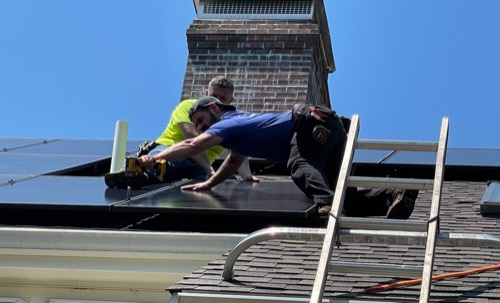
  5. Installation of Your System. The solar installer will handle the installation, including pulling any permits (e.g., building and electrical), along with executing an Interconnection Agreement with Eversource. After the required electrical inspections, Eversource will install a net meter that tracks both what power you produce and use, and give you approval to power up your system.
  6. Enjoy your new System. There is nothing quite like the feeling when you eventually see your first electrical bill for $0! It’s great knowing you are saving money AND doing your part to combat climate change. Many people really love the energy production/usage tracking apps that come with their system (e.g., Enphase’s EnlightenApp and SolarEdge’s MySolarEdge App). Getting the graphs and reports helps provide insight on your energy production/usage even down to a 15 minute interval!
  7. Let us know how it went! Add a testimonial at the bottom of this page.

Deep Dive

How do I know my home is good for solar?

Solar installers can do a quick virtual evaluation of the usable area of your roof, the shading of your roof, and the approximate number of hours of usable sunlight per year. Roofs that face south with little shade are best, but roofs that face east and west can work if there is little shade. Ideal roofs have large expanses of open areas but panels can be placed on smaller areas, as well. Remember that this is just a rough assessment. You need to request a free site visit from a solar installer for a more-accurate evaluation of your roof’s solar potential and economic returns.

What kind of maintenance is required on solar systems?

A solar array should be largely maintenance free over its 25+ year life. If you own your solar panels, one possible exception to this is the likely need to replace some inverters after several years. However, if you have chosen panels with inverters integrated into them, the inverters should be covered by the warranty and not need replacement during the life of the panel. Rain and snow will generally keep the panels clean and free of debris. Removing snow is not recommended because of the risk of damaging the panels. (Because they are made of smooth, tempered glass, snow slides off the panels as sunlight begins to warm them.) Even if your internet or reporting system goes down, the panels will keep producing; it is rare for the panels to stop functioning. All of that said, it is wise to for you to monitor your system and have the system inspected every so often to ensure all is well.  Certain monitoring apps provide per solar panel production information you can use to evaluate if certain panels are underproducing relative to adjacent ones (for non-shade related reasons).

How do Renewable Energy Certificates (RECs) in the current Massachusetts solar program work?

Under the current Massachusetts SMART solar program, the solar project’s associated Renewable Energy Certificates (RECs) are conveyed to the electric utility. Please note that household members should be aware that although they are generating solar electricity, the electric utility is actually selling those RECs to another entity. It is a tad confusing for the public, perhaps, but this is how the program works, and what makes it more economical for consumer participation. For more on RECs see the Renewable Energy Certificates (RECs) Factsheet).

How does “going solar” work?

Generally, a solar installer will request a copy of your electricity bill, and then prepare a proposed configuration and financial estimate based on your usage and space available for a solar photovoltaic (PV) array. Once you approve the design and sign a contract, the solar installer will handle the installation, permits, work scheduling, and ensuring the system is ready to connect to the grid. It may take a month or more until installation begins, but the actual installation usually takes only a couple of days. After required electrical inspections, Eversource will install a net meter and give you approval to power up your system. (see the Next Steps tab for some additional details)

What are other benefits of solar PV?

Solar PV panels (which sometimes include the inverter) are usually warrantied for 25 years and inverters for 10 years (if the inverter is separate from the panels); the panels usually require no maintenance. With the potential for free electricity to home buyers, solar panels may increase the value of your home without increasing your property tax bill. Learn about the experience of several homeowners who have installed solar in the Acton area by reading the testimonials below.

What is net metering and how does it help the solar customer?

Currently, residential solar systems in Massachusetts are allowed to use “net metering“. Net metering credits the owner of the array for every kWh of electricity produced by the system, regardless of whether that electricity is used now or in the future. For example, in the summer, you may produce more electricity than you consume in a given month, but the excess electricity that you did not use gets put onto the electrical grid and you get full credit for that electricity when you need to use it later, such as during the winter months.

Net metering is done by changing the utility’s electric meter on your home to a “net meter” that runs both forward and backward. When you use more electricity than you produce, the meter runs forward. When you produce more electricity than you use, the meter runs backward. Your utility bill is based on the net meter reading each month. For any months in which you produce more electricity than you use, the net meter reading for the month will be negative, and you will get a credit on your bill for the excess electricity. This credit will automatically be carried forward and then applied to reduce your bills in later months when you use more electricity than you produce.

Where can I get more information?

Learn more about solar (and other renewable energy) at Massachusetts DOER,  the Massachusetts Clean Energy Center, and EnergySage.com.

Last Updated 2/25/26

Testimonials

Installing rooftop SOLAR was our 1st home 🏡 decarbonization step! We worked with New England Clean Energy to put panels on the back of our…
Installed Solar TWICE!
Submitted by: Karen Herther
In the end, we went with New England Clean Energy, out of Hudson, MA, to do our 2022 roof solar panels. We are really happy…
We LOVE our solar!!
Submitted by: Karen Root Watkins
Here's a link to my blog post about our Solar Installation https://iowasweetspot.blogspot.com/2020/08/rays-of-sun.html
Rooftop solar installation
Submitted by: Gauri Tandon

Add a Testimonial

0%